Few places in the continental United States offer the consistency and accessibility of wild parrot watching found in the Rio Grande Valley. Five species with established or regularly occurring populations are present across the Valley's cities and nature preserves — and knowing where and when to look puts spectacular views within easy reach.
The RGV's parrot story is one of the more remarkable wildlife narratives in North American birding. A combination of geography, climate, ornamental landscaping, and the legacy of the pet trade has produced something genuinely improbable: a region where flocks of wild parrots are a daily fact of urban life. Most Valley populations originated from escaped or released birds, though some natural cross-border movement also occurs — and only a subset of these species maintain consistent breeding populations. For visiting birders, these birds are often an unexpected highlight. For locals, they are simply part of the landscape — the raucous, brilliant, unmistakable soundtrack of a South Texas evening.
Looking for parrots at Bentsen–Rio Grande Valley State Park? Bentsen is one of the Valley's essential birding destinations, but it isn't a reliable spot for wild parrots — the park is best known for Green Jay, Elf Owl, Hook-billed Kite, Groove-billed Ani, Common Pauraque, Gray Hawk, Ringed and Belted Kingfisher, and four oriole species (Altamira, Orchard, Audubon's, and Bullock's). For parrot flocks, head to Tony Oliveira Park in Brownsville, covered below — and see our full Bentsen SP guide for what to expect there instead.
Tony Oliveira Park — The Place to Start
For any birder seeking RGV parrots, Tony Oliveira Park in Brownsville is the essential first stop. No other location in the Valley offers the same concentration of species, reliability, and spectacle. On a productive evening the park hosts Red-crowned Amazons, Red-lored Amazons, Green Parakeets, and Monk Parakeets — up to four of the Valley's five parrot species in a single visit. The evening roost is the main event: arrive an hour before sunset and watch the sky fill as flocks converge from across the city.
Brownsville has a deeper connection to its parrots than most cities. The Red-crowned Amazon has become an unofficial symbol of Brownsville — a reflection of the city's genuine affection for these birds and its long-term commitment to their protection.
The evening roost is the single most reliable and dramatic way to observe RGV parrots. Arrive at least 45 minutes before sunset. Birds begin arriving in small groups and numbers build steadily until the canopy is alive with color and noise. Tony Oliveira Park, Brownsville is the most reliable location in the Valley for observing multiple species in one visit.
The Five Species
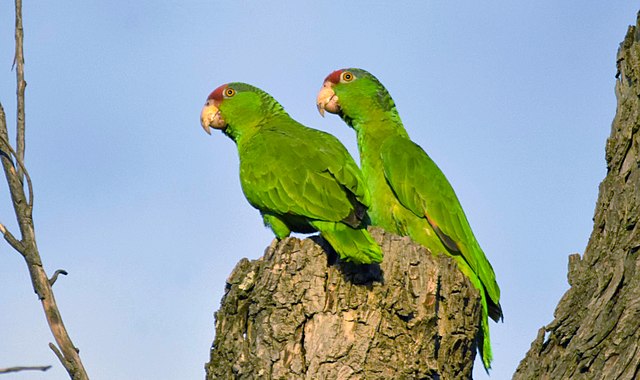
The Red-crowned Amazon is the flagship parrot of the Rio Grande Valley — the most numerous, most studied, and most culturally embedded of the region's parrot species. Mostly bright green with a vivid red crown patch, it is vocal, conspicuous, and unmistakable once you know what to look for. Flocks moving between roost sites are audible from considerable distance, and the evening roost gatherings rank among the most impressive wildlife spectacles the Valley has to offer.
Originally native to northeastern Mexico, the Red-crowned Amazon is classified as endangered in its native range due to habitat loss and decades of poaching for the pet trade. Many of the Valley's birds arrived during the 1970s and 1980s when import of wild-caught parrots was still legal; others have crossed the border naturally over time. Texas Parks & Wildlife recognizes the species as native in Texas — a critical legal designation that enables conservation research and protection efforts.
A landmark study led by researchers from Texas A&M University's School of Veterinary Medicine & Biomedical Sciences estimated the South Texas population at around 900 birds (with numbers varying by year), distributed across four primary roost centers: Brownsville, Harlingen, Weslaco, and McAllen. The research documented the species' remarkable success in urban environments — thriving on ornamental fruit-bearing plantings, nesting in cavities in dead palm trees and building structures, and showing a high tolerance for human activity that most endangered species cannot manage.
- 📍 Tony Oliveira Park — Brownsville
- 📍 Hugh Ramsey Nature Park — Harlingen
- 📍 Valley Nature Center — Weslaco
- 📍 McAllen E. Houston Ave roost
- 📍 Calvary Baptist Churchyard — Harlingen
- 📍 Estero Llano Grande SP
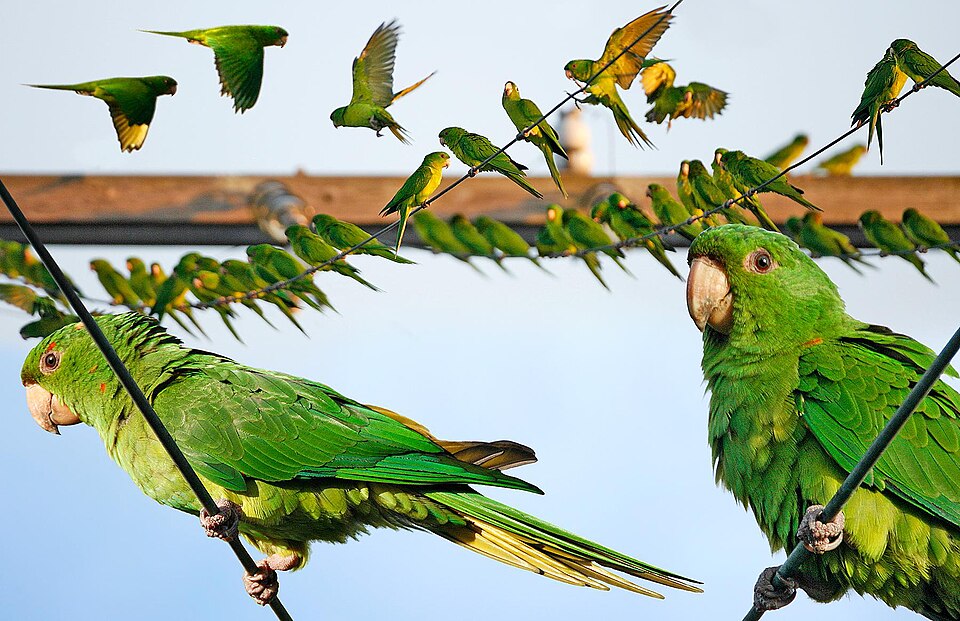
The Green Parakeet is the noisiest and most visible of the Valley's parrot species. All-green with a long pointed tail, these birds move in fast, chattering flocks that announce their presence long before they come into view. Like the Red-crowned Amazon, the Green Parakeet is recognized as a native species in Texas by the Texas Bird Records Committee. Along Shary Road in Mission, large flocks settle into shopping center palm trees and line up on power lines at dusk — a spectacle that requires no special access or early morning effort. The birds are very reliable if you're in the right area at the right time of evening.
The McAllen roost on North 10th Street — both north and south of Trenton Road — and the nearby West Dove Avenue intersection are among the most concentrated and accessible Green Parakeet sites in the Valley. These are drive-accessible locations where large roost flocks are visible from the road as evening approaches. The combination of Mission and McAllen sites makes the Green Parakeet the easiest of the Valley's parrots to find in impressive numbers.
- 📍 HEB Plus, Shary Rd — Mission
- 📍 Target, Shary Rd — Mission
- 📍 McAllen N. 10th St roost
- 📍 McAllen W. Dove Ave / N. 10th St
- 📍 Tony Oliveira Park — Brownsville
- 📍 Calvary Baptist Churchyard — Harlingen
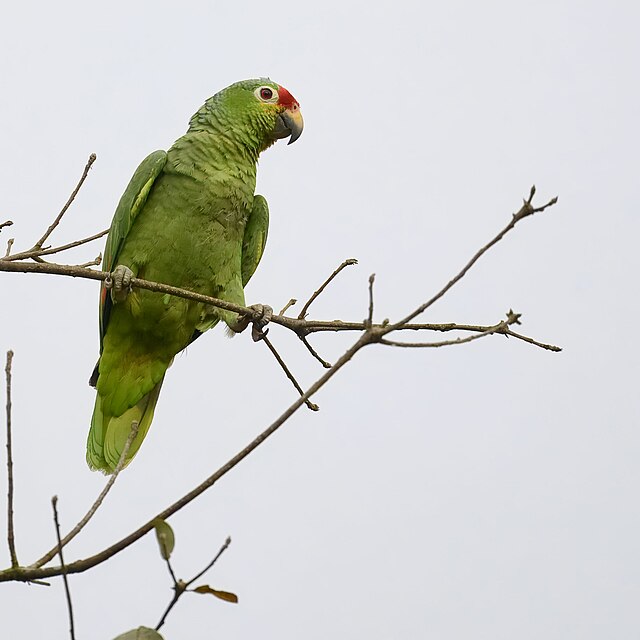
The Red-lored Amazon is a stockier, more compact bird than the Red-crowned, distinguished by its red forehead and lores and yellow cheek patches. It occurs in smaller numbers across the Valley but is a regular presence at Oliveira Park, where mixed Amazon flocks at the evening roost frequently include Red-lored individuals among the dominant Red-crowned birds. Frontera Audubon Center in Weslaco and the UTRGV Brownsville campus — including the resacas running through the grounds — are also productive sites.
When scanning a flock of Red-crowned Amazons, careful attention to head pattern will often reveal one or more Red-lored birds mixed in. The two species associate freely at roost and feeding sites, making Oliveira Park an excellent location to study both species in close comparison.
- 📍 Tony Oliveira Park — Brownsville
- 📍 Frontera Audubon Center — Weslaco
- 📍 UTRGV Brownsville campus
- 📍 Calvary Baptist Churchyard — Harlingen
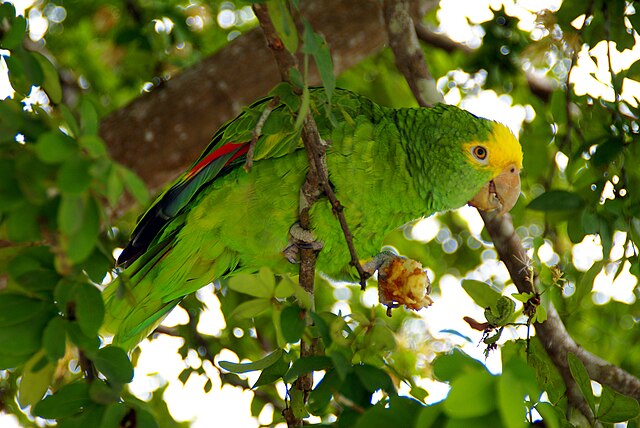
The Yellow-headed Amazon is the rarest of the Valley's regularly reported parrot species — a large, striking bird with a yellow head that becomes more extensively yellow with age. Present in small numbers and less predictable than the other Valley parrots, the species has a documented presence at Sabal Palm Sanctuary in Brownsville and at the McAllen East Houston Avenue roost, where it occasionally associates with Red-crowned Amazon flocks.
When present, a Yellow-headed Amazon in a flock of Red-crowned Amazons is straightforward to identify — larger, with the distinctive yellow head visible even in flight at a distance. Any Amazon roost flock at McAllen's East Houston Avenue site is worth scanning carefully for this species.
- 📍 Sabal Palm Sanctuary — Brownsville
- 📍 McAllen E. Houston Ave roost
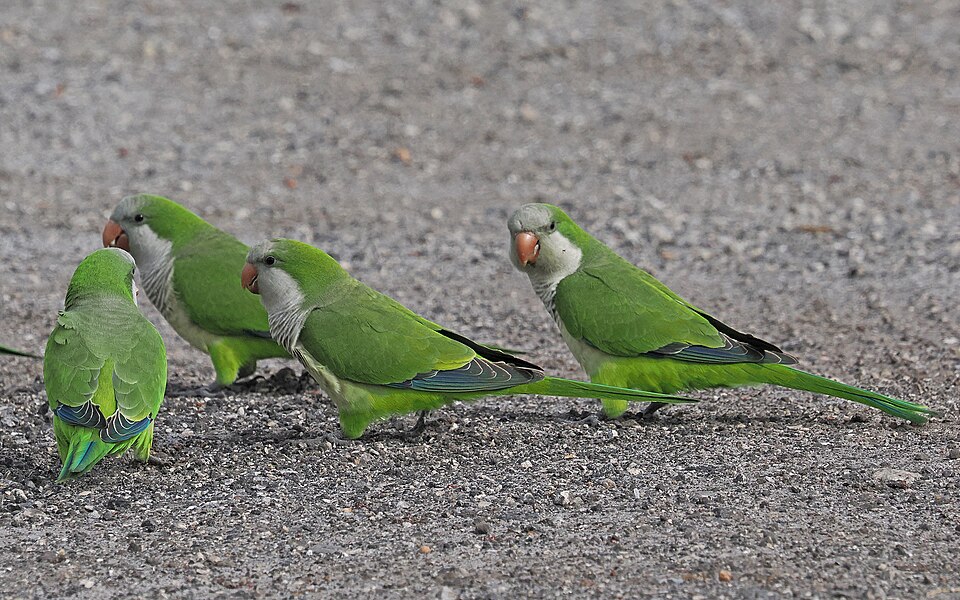
The Monk Parakeet is the Valley's most architecturally distinctive parrot — the only parrot species that constructs large communal stick nests, typically on utility poles and towers, used year-round. Green with a gray breast and face, these birds are social, conspicuous, and reliably found near their nest structures throughout the day. The Old Hidalgo Pumphouse (World Birding Center, LTC 067) hosts an active colony, and Oliveira Park in Brownsville is a reliable second site.
The nest structures themselves are the easiest way to locate this species — look for large, untidy masses of sticks on utility poles and power infrastructure in urban areas. Once an active nest is located, the birds are typically present in the immediate area throughout the day, making this the most daytime-accessible of the Valley's parrot species.
- 📍 Old Hidalgo Pumphouse WBC
- 📍 Tony Oliveira Park — Brownsville
An Endangered Species Finding Stability in an Adopted Home
A landmark study led by Dr. Donald J. Brightsmith and researcher Simon Kiacz from Texas A&M University's School of Veterinary Medicine & Biomedical Sciences documented the scope and success of the Valley's Red-crowned Amazon population. Their findings, published in the scientific journal Diversity, estimated a South Texas population of approximately 900 birds across four primary roost centers — Brownsville, Harlingen, Weslaco, and McAllen.
The research found that urban environments have been unexpectedly well-suited to these birds. Ornamental plantings provide consistent food sources; dead non-native palms and building cavities serve as nest sites; and the species' tolerance for human activity has made dense residential and commercial neighborhoods functional year-round habitat. As one researcher noted, humans have essentially created a highly suitable environment for these parrots — ornamental fruit-bearing plants, well-watered year-round, supply exactly what the birds need.
Texas Parks & Wildlife's decision to grant the Red-crowned Amazon native species status was central to enabling these protections. The designation allows for formal conservation investment and legal protection that would otherwise be unavailable to an introduced species. The RGV's Red-crowned Amazon population represents one of the more consequential conservation stories in North American urban birding — a species endangered in its native Mexico finding a stable, growing population across the river in South Texas.
Field Strategy
The evening roost is the single most productive approach for all five Valley parrot species. Birds that have dispersed across urban areas during the day converge at predictable roost sites beginning roughly 60 to 90 minutes before sunset. Flocks build progressively — what begins as a few birds calling from the canopy becomes a sustained spectacle of noise and color as darkness approaches. Arriving early and positioning yourself with a clear view of the sky is the most effective strategy.
Tony Oliveira Park, Brownsville remains the single best location in the Valley for parrot diversity. For Green Parakeets specifically, the Mission and McAllen roosts along Shary Road and North 10th Street offer numbers and accessibility that rival any parrot-watching experience in the country. These are not wilderness destinations — they are city parking lots and power lines at dusk, which makes them accessible to any visiting birder with a car and a free evening.
Along Shary Road in Mission, Green Parakeets gather on power lines and in the palm trees of commercial parking lots in the evening hours — the HEB Plus and Target locations are useful reference points. In McAllen, the North 10th Street corridor both north and south of Trenton Road, and the West Dove Avenue / North 10th Street intersection, are established roost sites where large flocks are visible from the road as the light fades.
Recent Sightings at Oliveira Park
Live data from eBird — species reported at Tony Oliveira Park in the last 14 days. Updated each time you load the page.
Search Recent Parrot Sightings
Use the RGV Bird Finder to find the most recent eBird reports for each of the Valley's parrot species.